Sunday, November 2, 2014

In the ice!

64° 57 S, 64° 25 W
-2.1 °C (28°F)
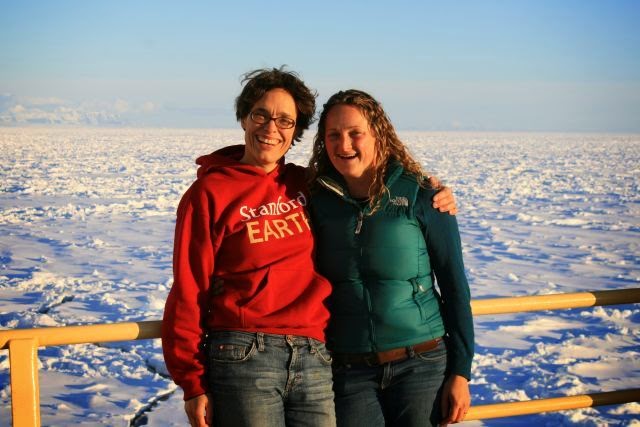
Science is in full swing on the Nathaniel B. Palmer. I’ll tell more about that later, but first some scenery! For the past two days we have been surrounded by sea ice, which makes a for beautiful ice scape. Even though the weather is overcast, the reflection makes everything very light. The roundish ice floes are called “pancake ice” and the structures are very cool to look at. When we go through it feels a bit like sailing through butter as the ice is pretty slushy. The bottom of the ice floes are brownish from the ice algae that grow there. They grow inside the ice and benefit from the little bit of light that shines through the ice and take up nutrients from the water below. Our wake through the white sea ice is brownish from the ice algae in the overturned ice floes, and we look back on the “yellow brick road” that brought us where we are.
Within the sea ice there are sometimes small icebergs, that are remnants of bigger icebergs. These icebergs have been floating around for sometimes a number of years, and have been battered by waves and weather. These small bergs still look very different from the sea ice around it.
On the ice floes we sometimes see seals that look very confused as we show up in their white world with our big orange boat. They are mainly Weddell seals, but we also saw a leopard seal. Those are pretty ferocious creatures and Shackleton wrote about being scared that his ponies would be eaten by the leopard seals. We haven’t seen many penguins yet, it may be too early.

My email on board is: Annecarlijn.Alderkamp.Guest@nbp.usap.gov
Here you can track our location: http://www.sailwx.info/shiptrack/shipposition.phtml?call=WBP3210

In the ice


Find the lonely seal

Pan cake ice

Sunday, October 26, 2014

Port call in Punta Arenas

We are almost ready to leave! The past three days were very busy with getting ready for the trip. Unpacking boxes, counting supplies, setting up equipment, testing equipment, freaking out about missing stuff, locating the missing stuff, and unpacking more boxes. The weather was uncharacteristically nice, which made everything a whole lot easier in this rough part of the world. Almost everything worked out and almost all preparations are done. Both US icebreakers, LM Gould and NB Palmer were in Punta Arenas for the port call, and we met a lot of friends with whom we worked on previous cruises. Seeing all these people made it a warm welcome in this remote part of the world.
Both US Antarctic icebreakers Laurence M. Gould and Nathaniel B. Palmer docked at the pier in Punta Arenas, Chile

Palmer in beautiful weather

Pier in Punta Arenas
Then it was time for a last supermarket run and a last cup of coffee/beer. We are ready for our expedition! Departure in three hours, Drake Passage, Here we come!


Wednesday, October 15, 2014

Down south again


We are getting ready to go back to Antarctica! On Tuesday Oct 21 we will fly to Punta Arenas in Chile and on Sunday Oct 26 we hope to set sail on the research icebreaker “Nathaniel B. Palmer” to sample the waters of the Western Antarctic Peninsula, or the WAP as it is affectionately called. We are going in the early Antarctic spring, a lot earlier than previous expeditions. It will still be dark at night during our trip!

 Getting ready always comes with a mix of stress to get everything ready, sadness to leave home for so long, and excitement about going to Antarctica. Our gear was shipped months ago, which forces you to finalize the science planning well in advance, but there are always last minute adjustments and additions.  And there are the uncertainties of doing field work in Antarctica. We plan to do our research at the location of the Long Term Ecological Research site of the WAP: Palmer LTER.  This is of course a good plan, but the satellite data show a lot of sea ice where we want to go! So we’ll see where the phytoplankton hangs out when we get there. Fortunately, you can also see phytoplankton with the satellite, so we’re keeping a close eye on the daily satellite data that are delivered to our computer. Also, there are a number of satellite wind products that I’m keeping an eye on for the conditions in the Drake Passage, the windy bit of water we have to cross to get to our research site.

This is a pretty awesome site to watch the wind all over the globe http://earth.nullschool.net/#current/wind/surface/level/orthographic=-115.96,-89.44,345


 Right now it looks pretty manageable, so hopefully between now and two weeks the wind will stay calm, the ice will melt, and the phytoplankton will start to grow. Antarctica, here we come!

The Nathaniel B. Palmer in Punta Arenas, Chile.

Sea ice concentration in our study area.
The Nathaniel B. Palmer at the British Antarctic station Rothera, last year.

Monday, December 2, 2013

It is incredibly beautiful here! - Het is hier waanzinnig mooi!

The pictures speak for themselves. We are in the ice en route to the British Antarctic base Rothera and it is slow going, but it is incredibly beautiful! We should be at the Rothera base at 6 am tomorrow morning where part of the scientists will fly back to the US. But the ice does not cooperate and yesterday and today we could not get through. We have access to satellite images of the ice concentrations that give some information about the route to follow, but it is still difficult to navigate. Tonight an airplane on its way to Rothera flew by and told us what he could see from the air. "Sail east, looks good. See you on Rothera" was the message. So that is what we do now.

The sun still sets but it does not get dark anymore.


De foto's zeggen genoeg! We zitten in het ijs voor Rothera en het gaat trager dan we willen, maar het is geweldig mooi! We zouden morgenvroeg om 6 uur bij de Engelse basis van Rothera moeten zijn, waar een gedeelte van de wetenschappers terug naar Amerika vliegt. Maar het ijs werkt niet mee en gisteren en vanochtend kwamen we er niet doorheen. We hebben toegang tot satellite beelden van de ijsconcentraties die wat informatie geven over de te volgen route, maar het is nog steeds moeilijk om daarop te navigeren. Vanavond is er een vliegtuig van de Britten overgevlogen dat naar Rothera ging en die heeft ons verteld wat hij vanuit de lucht zag. "Vlieg naar het oosten, ziet er goed uit, zie je op Rothera" was het bericht. Dus dat doen we nu!

De zon gaat nog wel wat onder, maar het wordt al niet echt meer donker.


Wednesday, November 27, 2013

What a difference a day makes...

And not always in a good way. Yesterday, the crab team was deploying their crab pots on a sunny evening, with chinstrap penguins porpoising around the ship. Tonight, it is blowing 40 kn and the spray of the waves are hitting the windows of the bridge, which is 5 floors up. So no science at this point, we're doing "weather patterns" to wait until the wind dies down a bit, so we can resume our work. Time to let myself be rocked to sleep...


Saturday, November 23, 2013

We're in business!

Wind Speed (kn):        22.1
Wind Direction (True):  338.2
Air Temperature (C):    1.0
Wind Chill (C): -14.5
Sea Temperature (C):    0.5
Heading (deg T):        186.9
Course Made Good (deg): 190.8
Speed (kn):     10.1
Latitude: -61.6813   Longitude: -65.5576
Next Waypoint: camera crab survey site
Distance (nm):  137.5
Travel Time (hrs):      13.3


This morning we passed the Chilean EEZ, or Economic Exclusion Zone. Since we do not have a Chilean observer on board, we cannot do any science in Chilean waters and had to wait until early this morning to turn on our underway water sampling and sensor system. After this the Phantastic team didn’t waste any time and started hooking up equipment. We’re very excited to measure the first concentrations of gasses in the water and study the phytoplankton of the Drake Passage under the microscope and with the fancy new camera/microscope system we have, the Flowcam. Right now it’s still mainly tweaking and everything is looking good so far.
We are not far away from the Antarctic Peninsula, where the crab team will start looking for crabs on the slope of the Antarctic shelftomorrow. They will deploy a towed camera on a sled that can take photos from the sea floor to see if crabs are present. If they see some they will deploy crab traps to try to catch them. Everyone on the ship got to make a guess of how many they will catch and the numbers run from 7 4/5th to 685. We will see in a week!


Above: Casey and Laughlin are inspecting the Mass spec

Below: Hannah and Gert got the Flowcam to take pictures of phytoplankton

Drake's Passage

Drake's Passage

Latitude: -57.8908   Longitude: -64.8968

The Drake Passage is treating us well! 15 kn breeze, 12 ft swell, and sunshine! Time to photograph some birds! And enjoy the sunset while we still have one,

more soon,
Anna